
BloFin Exchange Review 2026: Fees, No-KYC Limits & Futures Trading
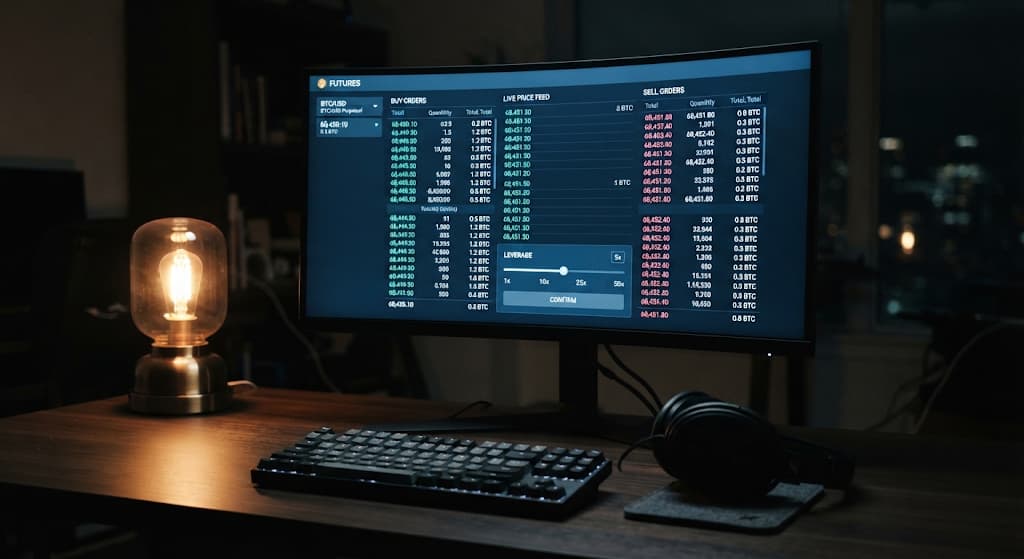
Most crypto exchange reviews spend their opening paragraphs establishing legitimacy — founding year, headquarters, user count. BloFin’s story is a little different, because it’s a newer, narrower platform that’s deliberately chosen to compete on exactly two things: how fast you can start trading futures, and how little you have to prove about yourself to do it. Whether that’s a feature or a red flag depends entirely on what you’re looking for, so it’s worth separating the genuine strengths from the real risks before deciding either way.
What BloFin Actually Is
BloFin is a centralized crypto exchange headquartered in the Cayman Islands, founded in 2019 and built primarily around derivatives trading rather than being a general-purpose spot exchange with futures bolted on as an afterthought. That focus shows: the platform runs perpetual futures with leverage options reaching up to 150x, offers both USDT-margined and coin-margined contracts, and pairs that with copy trading, automated trading bots, and a smaller spot market of roughly 400+ assets. It operates in more than 100 countries, with the US and China listed among its restricted regions — worth noting upfront, since BloFin’s own terms of service don’t extend coverage to US residents regardless of what any third-party promotional content might imply.
The No-KYC Feature, Explained Properly
This is BloFin’s most-searched and most-discussed characteristic, and it’s genuinely accurate, within limits. New users can register with just an email or phone number, enable two-factor authentication, and start trading without submitting any identity documents — as long as daily withdrawals stay under 20,000 USDT. Cross that threshold, or want to use fiat on-ramps, and full verification becomes mandatory.
That’s a materially different model from an exchange like Coinbase, where identity verification is a day-one requirement, and even more permissive than MEXC’s increasingly tightened 2026 policy. It’s a real convenience for traders who value speed and privacy and who aren’t moving large daily sums. It’s also a real responsibility: an exchange with a lighter verification bar is, by the nature of that trade-off, operating with less of the regulatory infrastructure that gives US and EU-licensed platforms their consumer protections. That’s not a claim that BloFin is unsafe — it publishes standard security practices and hasn’t reported a major breach — but it is a structurally different risk profile than a bank-licensed exchange, and it’s worth going in with eyes open about that difference.

What Trading on BloFin Actually Costs
BloFin’s fee structure sits right in line with other major derivatives-focused exchanges, which makes sense given how much of the platform’s identity is built around futures.
| Market | Maker fee | Taker fee |
|---|---|---|
| Spot trading | 0.10% | 0.10% |
| Perpetual futures (standard) | 0.02% | 0.06% |
| Futures, top VIP tier | 0.00% | ~0.035% |
Those futures rates land close to what Binance, Bybit, and OKX charge at their base tiers, so BloFin isn’t winning on futures pricing alone — it’s competing on access and speed of onboarding instead. Deposits are free aside from standard network costs, and withdrawals only carry the blockchain’s own gas fee, with no additional platform surcharge.
The Leverage Question Deserves Its Own Paragraph
150x leverage is an extreme figure worth pausing on rather than treating as just another spec in a features list. At that multiple, a price move of less than one percent against your position can wipe out your entire margin. High-leverage futures trading is a fundamentally different activity from buying and holding spot crypto, and the platforms offering the highest leverage ceilings tend to attract traders chasing fast gains who underestimate how fast losses compound in the other direction. If you’re new to derivatives, the leverage number that matters most isn’t the maximum the platform allows — it’s the much lower number you’d actually be comfortable using, with a clear-eyed understanding that liquidation on a leveraged position can happen in minutes during a volatile swing.
How BloFin Stacks Up Against the Field
Compared to the no-KYC derivatives exchanges it’s most often grouped with, BloFin holds a reasonably competitive position: its $20,000 daily no-KYC withdrawal limit sits below some competitors offering higher thresholds, but its fee schedule and 440+ futures contracts are broadly comparable. Against the larger regulated players like Coinbase or Kraken, BloFin isn’t really a substitute — it’s a different category of product aimed at a different kind of trader, with a smaller spot catalog, no Earn or staking ecosystem to speak of, and a product lineup built almost entirely around short-term, leveraged positioning rather than long-term holding.

Common Questions About BloFin
Deciding If It Fits What You’re Actually Doing
BloFin isn’t trying to be everyone’s exchange, and reviewing it honestly means judging it against what it’s actually built for: fast, low-friction access to leveraged derivatives trading for people who already understand what that entails. For that specific use case, the fee structure is competitive and the onboarding genuinely is faster than most regulated alternatives. For anyone newer to crypto, or anyone whose main goal is simply buying and holding a long-term position, the better fit is almost certainly a platform with full verification, deposit insurance structures, and a product lineup that doesn’t lead with 150x leverage as a headline feature. As Wes Ibarra puts it when sizing up exchange claims against what they actually deliver, "My job is to ask for the methodology anyway — and to give credit on the rare occasions the math actually holds up." Matching the exchange to the actual task, rather than the flashiest number on the homepage, is the same discipline worth applying everywhere in this space — exchanges included.
Related guides
 One Review Site Gave Coinstore Both a 2.89 and a 9.8 Out of 10Traders Union rates Coinstore as high-risk on one page and near-perfect on another. Here's…
 What Is Tongue Weight?The tongue weight is one of the most important limits to consider when towing…
 What Is GVWR? Everything You Need To KnowAll vehicles have something in common and it doesn't matter if you are driving…
 2021 Ford Escape Tow Package | What You Get!Since the 2021 Ford Escape had a towing capacity, it also had a tow…
 2022 Ford Escape Towing Capacity (W/ Chart)The 2022 Ford Escape has definitely changed on the outside over the years, but…
 2013-2014 Ford F-150 Towing Capacity, A Resource GuideThe 2014 Ford F-150 came equipped with four different engine options and five different…