
Kraken Exchange in 2026: Coins, Fees, Volume & US Availability

Type "kraken" into Google and you’ll get a strange mix of results: a cryptocurrency exchange, a mythical sea monster, a line of kayaks, and — if autocomplete has its way — a misspelling, "kracken exchange," that somehow refuses to die. For a company that’s been operating since 2011, it’s remarkable how much confusion still surrounds the basics: what Kraken sells, what it costs, and whether it’s even legal to use where you live.
This isn’t a listicle of "top 10 reasons to love Kraken." It’s a straight accounting of what the Kraken marketplace actually offers in 2026, pulled from the company’s own fee schedules, regulatory filings, and third-party audits — the kind of sourcing that should back up any claim about where your money is going.
First, Clearing Up What Kraken Even Is
Kraken is a cryptocurrency exchange — a company, not a coin. The legal entity behind it is Payward, Inc., founded in San Francisco in 2011, making it one of the oldest exchanges still operating without a major security breach on its record. There is no "Kraken coin" or "Kraken token" that trades on the open market in the way Bitcoin or Ethereum does. If you’ve seen a token calling itself "Kraken" on a decentralized exchange, that’s an unrelated project riding on brand recognition — always check the contract address and official Kraken channels before touching anything with that name.
That distinction matters because it also explains why "Kraken market cap" isn’t a meaningful search in the way "Bitcoin market cap" is. Kraken the company has a valuation, not a market cap — and that valuation has been very publicly in motion. Kraken confidentially filed paperwork with the SEC in November 2025 to go public, paused those plans in March 2026 when market conditions soured, then picked the process back up later in the year with a fresh S-1 filing. As of this writing the company remains privately held, last valued somewhere in the $15–20 billion range depending on which funding round you’re citing — real money, but still not a publicly tradable stock, let alone a token.
Is Kraken Available in the US?
Yes, with two notable exceptions. Kraken operates in most US states as a FinCEN-registered Money Services Business, and in some states it holds additional licenses that let it offer a broader product set. The two holdouts are New York and Maine, where regulatory requirements have kept Kraken off the approved list for years. If you’re trading Kraken from either state, you’ll need to look elsewhere or use a different verified identity — something the platform’s compliance systems are specifically built to catch, so it’s not a workaround worth attempting.
Beyond the exchange basics, Kraken has also pushed into US stock and ETF trading — reportedly more than 11,000 listed securities — available to eligible US residents outside of New York and Maine, layering traditional markets on top of its crypto offering.
Walking Through What’s Actually on the Platform
"Kraken products" covers more ground than most people expect. The platform splits broadly into:
- Instant Buy — the beginner-friendly interface, built for simplicity rather than cost efficiency
- Kraken Pro — the advanced order-book interface with the lowest available fees
- Staking / Auto-Earn — reward-earning programs on a subset of supported assets
- Margin and futures trading — leveraged positions through a dedicated futures terminal, including up to 50:1 leverage on some contracts
- Kraken+ — a flat monthly subscription that waives standard trading fees up to a set monthly volume
- Stock and ETF trading — available to qualifying US users outside NY and Maine
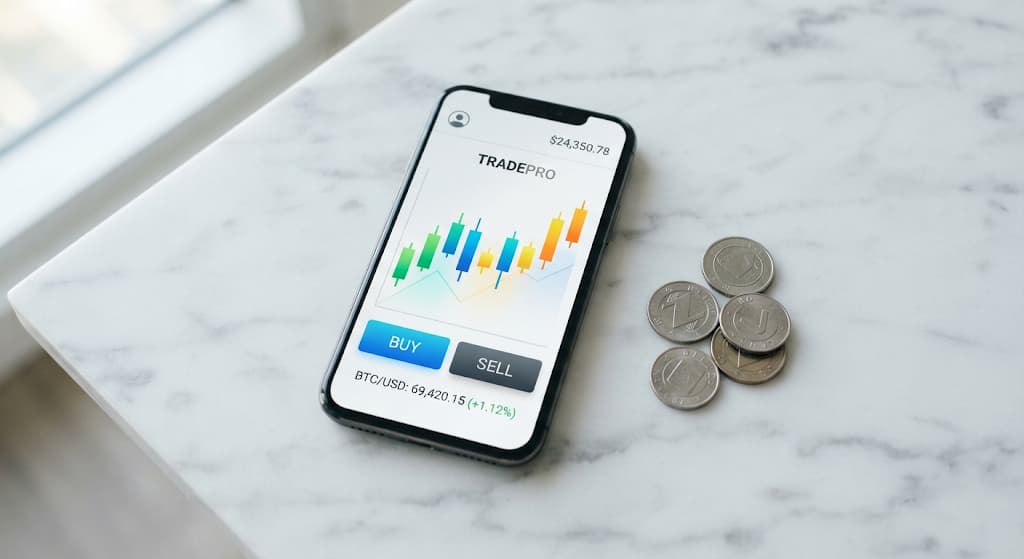
It’s worth being honest about the gap between these tiers. Instant Buy is where most new users land, and it’s also where the real cost of using Kraken shows up.
What Trading on Kraken Actually Costs
This is where the gap between "Kraken trading" on the beginner app and on Kraken Pro becomes impossible to ignore.
| Trading method | Typical fee | Who it’s for |
|---|---|---|
| Instant Buy (basic app) | ~1–1.5% flat fee, plus spread and payment-method surcharges | New users prioritizing simplicity |
| Kraken Pro (entry tier) | 0.25% maker / 0.40% taker | Traders comfortable with an order-book interface |
| Kraken Pro (high volume, $10M+/30 days) | As low as 0.00% maker / 0.10% taker | Active or institutional traders |
| Kraken+ subscription | $4.99/month, 0% fees up to $10,000 monthly volume | Regular small-to-mid traders on the standard app |
The pattern is consistent across nearly every independent review: Kraken Pro’s fees are genuinely competitive against Coinbase Advanced and sit in a similar range to other major exchanges, while the simplified app charges a real premium for convenience. If you only ever use the basic buy button, you are, in effect, paying for hand-holding you may not need.
Coins on Kraken: How Big Is the List, Really
Kraken’s coin list has grown substantially from its early Bitcoin-and-a-few-altcoins days. Depending on the source and the date it was checked, estimates range from roughly 220 to over 700 supported cryptocurrencies — the wide range mostly reflects how quickly exchanges add new listings and how different trackers define "supported." What’s consistent is the core: Bitcoin, Ethereum, major stablecoins like USDT and USDC, and large-cap names such as XRP and Cardano sit at the top of trading volume, with staking enabled on a few dozen of the broader coin list. If a specific kraken coin price or a current kraken crypto list matters for your decision, check it directly on the exchange rather than trusting a cached figure — listings and staking eligibility shift by the month, and regional availability can differ by country.
Trading Volume and Where Kraken Sits in the Market
Kraken’s trading volume fluctuates with the broader market, as it does for every exchange — spiking during volatile weeks and flattening during quieter stretches. It is not among the top two or three exchanges by raw volume (that tier is typically dominated by a small handful of larger players), but it has held a consistent position among the most trusted mid-to-large exchanges for over a decade, largely on the strength of its security record rather than sheer size. For traders weighing "kraken volume" against competitors, the more useful question is usually liquidity on the specific pair you want to trade, since thin order books on smaller coins can matter more than a platform’s headline numbers.

A Few Questions People Actually Ask
What This Actually Means If You’re Deciding Whether to Use It
Kraken earns its reputation less from being the cheapest or the biggest and more from being boring in the best sense — over a decade in an industry that’s lost plenty of exchanges to hacks and collapses, it hasn’t had a customer-funds-lost security incident. That track record, combined with a genuinely competitive fee structure once you move past the beginner interface, is why it keeps showing up on "best of" lists even as flashier competitors come and go. As Wes Ibarra, who writes about where crypto infrastructure claims actually hold up under scrutiny, puts it: "Most ‘green crypto’ claims fall apart the moment you ask for the methodology. My job is to ask anyway — and to give credit on the rare occasions the math actually holds up." The same discipline applies here: check the current fee schedule, check your state’s availability, and don’t assume a search result from six months ago still reflects what’s on the platform today.
Related guides
 Korea’s First Crypto Exchange Has Two Buyers Circling It This YearFounded in 2013, Korbit now sees Bybit and Mirae Asset both reportedly pursuing a…
 What Is Tongue Weight?The tongue weight is one of the most important limits to consider when towing…
 What Is GVWR? Everything You Need To KnowAll vehicles have something in common and it doesn't matter if you are driving…
 2016 F-150 Towing Capacities (With Charts)The 2016 F-150 had four different engine options to choose from, which affected the…
 2007 Hyundai Santa Fe Towing Capacities (With Charts)The 2007 Hyundai Santa Fe was much larger than the Tucson and it had…
 What Is A Tow Rope?Tow ropes are durable, heavy duty lengths of rope designed for towing, recovery, and…